
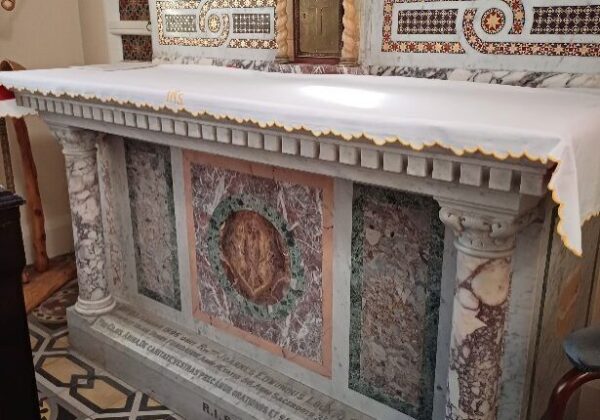

The Altar-stone in the chapel at Bishop’s House
The past week I have spent time working with slabs of marble- altar stones to be specific. We have over 25 in our collection which we are adding to our electronic catalogue. They come from the altars of closed chapels and portable mass kits of deceased clergy.
According to the Catholic Encyclopedia Dictionary (Copyright 1941, The Gilmary Society)-
An Altar-stone or Portable Altar is a small flat slab of natural stone, consecrated ordinarily by a bishop, containing in a stone covered cavity relics of two canonised martyrs, inserted into the centre of the table of an altar which is not entirely consecrated. The host and chalice are placed on this stone during the Sacrifice of the Mass. The stone is portable and may be placed in any suitable altar: It really constitutes the Altar.
Since 1983 fixed or portable altars do not need a separate inset altar stone.


The placement of the relics can be seen on these stones
The space for the relics in a stone where they have been removed.

Often the stones were covered in white linen.

The place for the stone can be seen in this World War II chaplain’s portable altar.

This is the altar-stone that is part of Bishop Pompallier’s portable altar- the thin linen covering coloured by age.


The majority of altar-stones in our collection blocks of marble, between A5 and A4 size and an inch thick. I make sure there are no more than three in a box as they are heavy! We have two stones that are crafted from slate.
We often receive enquiries asking what relics are in the altar stone. Unfortunately, it is rarely recorded. Here are two rare altar stones – one records who consecrated the stone, the other names the saints whose relics are contained within.


Leave a Reply